Magnetic vs Non-Magnetic RJ45: When Do You Need Magnetics?
Jul 13, 2026
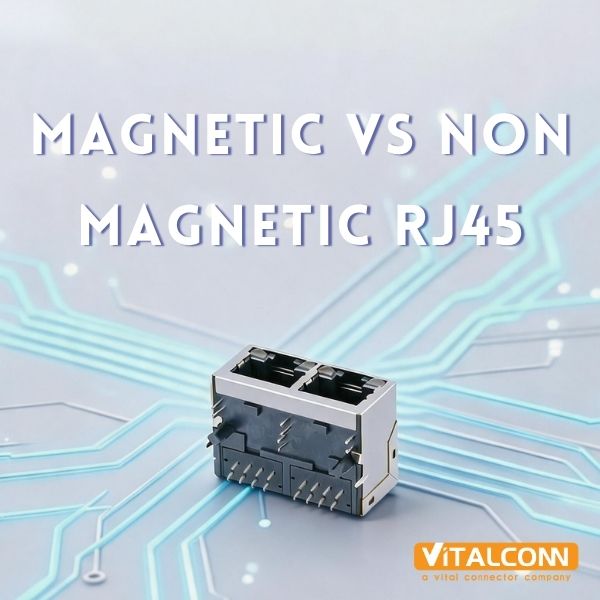
One of the most important decisions when specifying an RJ45 connector is whether to use a magnetic (ICM) or non-magnetic variant. This choice affects PCB design, BOM cost, PoE capability, EMI performance, and regulatory compliance. In this article, we explain the difference, when each type is appropriate, and why most modern designs choose magnetic RJ45 (ICM).
What Is a Magnetic RJ45 (ICM)?
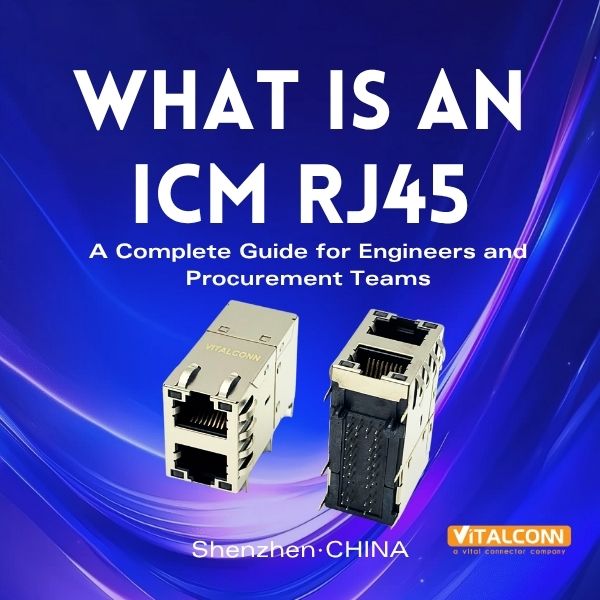
A magnetic RJ45, also called ICM (Integrated Connector with Magnetics) or magnetic modular jack, has signal transformers and common-mode chokes built directly into the connector housing. These magnetic components provide:
Transformers isolate the PHY (physical layer transceiver) from the cable, typically providing 1500VAC isolation per IEC 60603-7. This protects the PHY from voltage surges on the cable.
Common-mode chokes suppress common-mode EMI on each differential pair, reducing radiated emissions and improving immunity to external noise.
Center tap of each transformer provides the connection point for DC power injection (PoE) or extraction. Without a center-tapped transformer, PoE is not possible.
Turns ratio (typically 1CT:1CT) matches the impedance between the PHY (100 ohms differential) and the cable (100 ohms).
What Is a Non-Magnetic RJ45?
A non-magnetic RJ45 has no internal transformers or chokes. It is simply an 8-contact mechanical connector. The magnetics must be placed elsewhere on the PCB as discrete components. Non-magnetic RJ45 connectors are less expensive, but they shift the burden of magnetic component selection, placement, and compliance to the PCB designer.
Magnetic vs Non-Magnetic: Side-by-Side Comparison
Feature
Magnetic RJ45 (ICM)
Non-Magnetic RJ45
Internal magnetics
Yes (transformers + chokes)
No
Signal isolation
1500-5000 VAC
None (relies on external magnetics)
PoE support
Yes (center-tapped transformers built in)
Requires external center-tapped magnetics
EMI filtering
Built-in common-mode chokes
Requires external chokes
PCB complexity
Simple (fewer components to place)
Complex (must place and route discrete magnetics)
BOM count
Fewer parts (magnetics integrated)
More parts (connector + discrete magnetics + chokes)
IEEE compliance
Factory-guaranteed (pre-tested)
Designer responsibility (must verify)
Cost (connector only)
Higher
Lower
Cost (total system)
Often lower (fewer components, less PCB area)
Can be higher when counting discrete magnetics
Design flexibility
Less flexible (fixed magnetic specs)
More flexible (choose any magnetics)
Space efficiency
Very efficient (magnetics inside connector)
Less efficient (connector + magnetics area)
Typical use
Most networking equipment, PoE switches, industrial Ethernet
Cost-sensitive designs, custom magnetics needed, space-constrained
When to Use Magnetic RJ45 (ICM)
PoE applications: If your design requires PoE (802.3af/at/bt), you need center-tapped transformers. ICM has them built in.
IEEE 802.3 compliance: Most commercial networking equipment (switches, routers, NICs) uses ICM for guaranteed IEEE compliance.
Simplified PCB design: ICM reduces PCB component count and routing complexity, speeding up design cycles.
EMI compliance: ICM's integrated common-mode chokes reduce radiated emissions, helping pass FCC/CISPR tests.
Reliability: Fewer discrete components means better MTBF and fewer failure points.
Space constraints: In dense designs, the magnetics are hidden inside the connector, saving PCB real estate.
When to Use Non-Magnetic RJ45
Existing PCB with discrete magnetics: If you already have a discrete magnetics layout on your PCB from a previous design iteration.
Custom magnetics: If you need non-standard turns ratios or custom magnetic specifications not available in ICM.
Cost-critical consumer: For ultra-low-cost consumer devices where PoE is not needed and EMI requirements are relaxed.
Legacy designs: Some legacy designs and specialized industrial equipment use discrete magnetics for serviceability.
Industry Trend: Over 90% of new Ethernet designs use ICM (magnetic RJ45). The simplified design flow, guaranteed compliance, and total system cost advantage outweigh the higher per-unit connector cost.
PoE and Magnetic RJ45: A Critical Relationship
PoE (Power over Ethernet) delivers DC power over the same cable as data. The power is injected at the center tap of the signal transformer. This means the transformer must handle both the AC data signal and the DC power current simultaneously.
PoE Type
Power at PD
Current per Pair
Transformer Requirement
802.3af (Type 1)
12.95W
~0.35A
Standard ICM, low current
802.3at (Type 2)
25.5W
~0.6A
ICM rated for PoE+
802.3bt Type 3
51W
~0.6A per mode (2 modes)
ICM with dual-mode center taps
802.3bt Type 4
71W
~0.96A per mode (2 modes)
ICM with high-current center taps, thermal-rated
At 90W (Type 4), each transformer winding carries nearly 1A of DC current. If the transformer core is undersized, magnetic saturation occurs, causing signal distortion, overheating, and potential fire. VITALCONN's PoE++ ICM RJ45 connectors use oversized ferrite cores and thermally-rated wire to handle the full 90W without saturation.
EMI Performance: Why Magnetics Matter
The common-mode choke inside an ICM RJ45 is critical for EMI compliance. Without it, common-mode noise from the PHY couples directly onto the cable, which acts as an antenna, radiating emissions that can exceed FCC Class A limits. VITALCONN's ICM RJ45 connectors include common-mode chokes on every pair, providing 25-35 dB of common-mode rejection from 30 MHz to 500 MHz. This is essential for passing FCC/CISPR radiated emissions tests, especially for 10GBase-T where the signal spectrum extends to 500 MHz.
VITALCONN Magnetic RJ45 (ICM) Product Line
VITALCONN manufactures 163+ ICM RJ45 models, making us one of the most comprehensive ICM suppliers in the industry. Our magnetic RJ45 product line covers:
Category
Models
Key Specs
10/100Base-T ICM
30+
1:1 CT, 1500VAC, 2-pair PoE
1000Base-T (1G) ICM
50+
1:1 CT, 1500-3000VAC, PoE/PoE+/PoE++
2.5G/5GBase-T ICM
15+
1:1 CT, 1500VAC, low insertion loss
10GBase-T ICM
10+
1:1 CT, 5000VAC, enhanced EMI shield
Stacked (2xN) ICM
30+
2x1 to 2x8, shared/independent magnetics
Non-Magnetic RJ45
20+
For designs with external magnetics
Why choose VITALCONN ICM?
Full speed range: 10/100M to 10GBase-T
Full PoE range: 802.3af (15.4W) to 802.3bt Type 4 (90W)
Hi-Pot isolation: 1500-5000 VAC
Operating temperature: -40°C to +85°C (industrial)
Common-mode rejection: ≥ 25-35 dB (30-500 MHz)
ARP cross-reference: 26 replacements for Pulse, BelFuse, TE, Molex, Amphenol
Custom gold plating: flash to 50 microinches
Tip: VITALCONN's ARP platform provides 26 pin-to-pin cross-reference replacements for Pulse, BelFuse, TE, Molex, and Amphenol ICM RJ45 connectors. Benefits include 30-40% cost savings and 2-4 week lead times vs. 12-24 weeks for major brands.
Frequently Asked Questions (FAQ)
Do I need a magnetic RJ45 for PoE?
Yes. PoE requires center-tapped transformers to inject DC power onto the cable. A non-magnetic RJ45 does not have transformers, so it cannot support PoE. You would need external center-tapped magnetics on the PCB. Using an ICM (integrated magnetic) RJ45 simplifies this, as the center taps are built in.
Can I use a non-magnetic RJ45 with external magnetics?
Yes. Some designs use a non-magnetic RJ45 connector with discrete transformers and common-mode chokes placed on the PCB. This is common in legacy designs or when custom magnetic specifications are needed. However, most new designs use ICM for simplified layout and guaranteed compliance.
What is the turns ratio for RJ45 magnetics?
The standard turns ratio for Ethernet magnetics is 1CT:1CT (1 center-tapped to 1 center-tapped), which provides a 1:1 impedance ratio matching the 100-ohm PHY to the 100-ohm cable. Some specialized applications use 1CT:1.41CT or other ratios for impedance matching to non-standard cable impedances.
What is Hi-Pot isolation in ICM RJ45?
Hi-Pot (high-potential) isolation is the voltage the transformer can withstand between the primary (PHY side) and secondary (cable side) windings without breakdown. The minimum per IEC 60603-7 is 1500 VAC RMS. Industrial and medical applications may require 3000-5000 VAC. VITALCONN offers ICM models with isolation up to 5000 VAC.
Can I use a 10/100M ICM for Gigabit Ethernet?
No. A 10/100M ICM only has magnetics on 2 pairs (pins 1-2 and 3-6). Gigabit Ethernet (1000Base-T) requires magnetics on all 4 pairs. You need a Gigabit-rated ICM with 4-pair magnetics. Using a 10/100M ICM on a Gigabit port will prevent the link from establishing.
How does VITALCONN's ICM compare to Pulse or BelFuse?
VITALCONN's ARP platform provides 26 pin-to-pin cross-reference replacements for Pulse Electronics, BelFuse, TE Connectivity, Molex, and Amphenol RJ45 connectors. Our ICMs offer equivalent electrical specifications with 30-40% cost savings and 2-4 week lead times versus 12-24 weeks for major brands. Contact sales@vitalconn.com for a cross-reference.
Need Magnetic RJ45 (ICM) Connectors?
VITALCONN manufactures 163+ ICM RJ45 models with ISO 9001 certified quality.Request free samples or a custom quote.
Explore RJ45 ConnectorRequest Samples
Read More




 IPv6 network supported