Leave A Message
If you are interested in our products and want to know more details,please leave a message here,we will reply you as soon as we can.
submit

SFP28 cage

Home

SFP28 cage

  • SFP vs SFP+ vs SFP28: Which Cage Should You Use?
    SFP vs SFP+ vs SFP28: Which Cage Should You Use?
    Sep 28, 2026
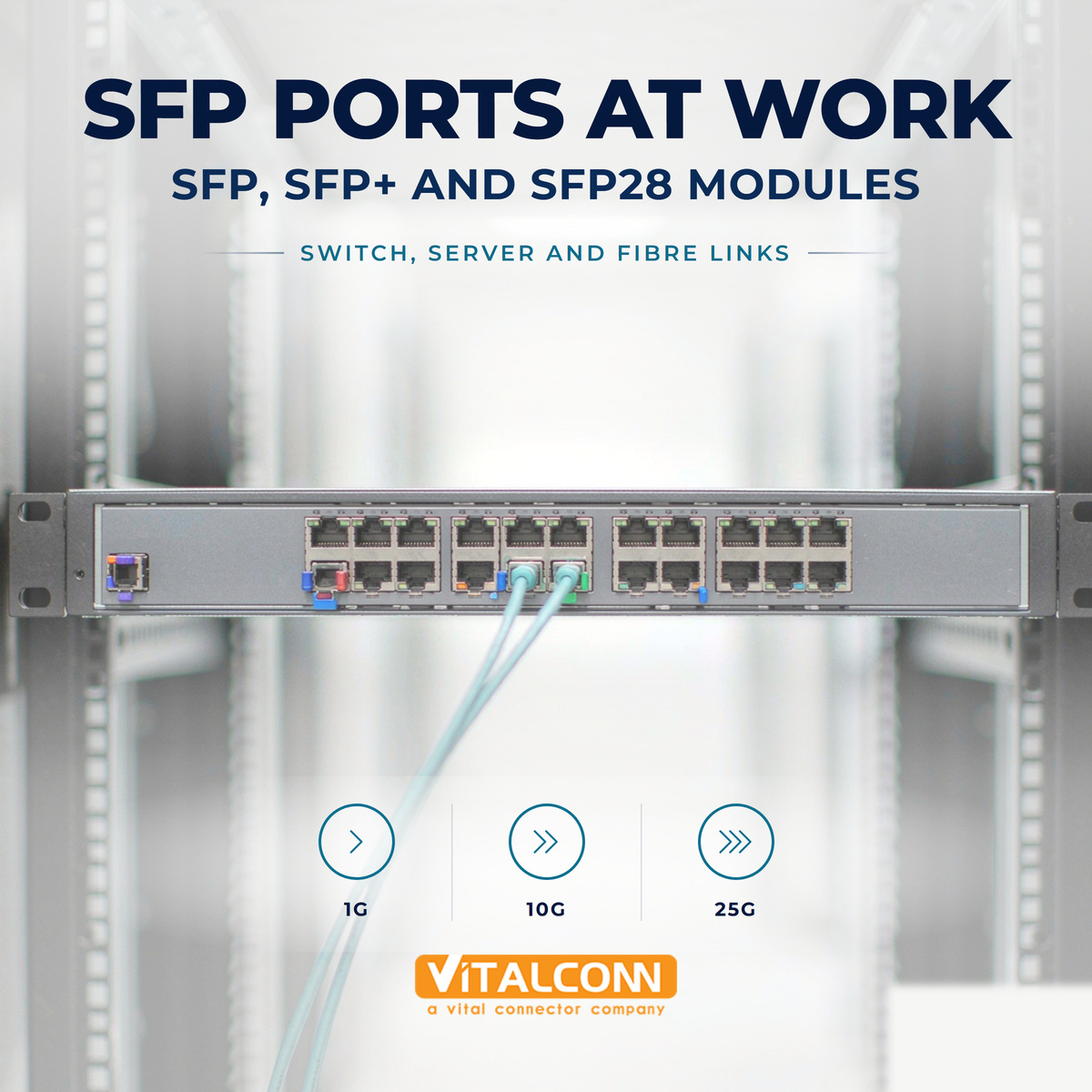
    SFP vs SFP+ vs SFP28: One Form Factor, Three Electrical Classes The SFP vs SFP+ vs SFP28 question looks confusing because the three names describe the same mechanical envelope carrying three different electrical generations. SFP modules run 1 Gbps. SFP+ modules run 10 Gbps. SFP28 modules run 25 Gbps. All three plug into the same physical port profile, all use the same 20-pin connector interface, and all fit cages drawn from the same MSA mechanical family. The differences that matter — signal integrity class, EMI shielding quality, thermal demand — live in the cage's electrical grade and in what your board does around it. Attribute SFP SFP+ SFP28 Module data rate 1 Gbps 10 Gbps 25 Gbps MSA generation SFF-8074/8432 era SFF-8431 SFF-8419 / 25G ecosystem Mechanical envelope Common Common Common Connector interface 20-pin 20-pin 20-pin Cage SI requirement Basic 10G-class 25G-class Typical module power Low Moderate Higher — thermal matters more Typical port Fast/Gigabit Ethernet 10G Ethernet, Fibre Channel 25G Ethernet, 5G fronthaul What Actually Differs: The Electrical Grade of the Cage Since the SFP+ cage and the SFP28 cage share dimensions with a classic SFP cage, the vendors' differences show up in the specifications you cannot see from the outside: crosstalk between the TX and RX pair bundles inside the connector, impedance continuity through the contact array, the pitch and force of the EMI spring fingers, and the availability of gasket-sealed bezels. A cage family intended for 25G publishes this data; a commodity 1G cage does not, which itself is information. The practical selection rule: buy the cage class at or above the fastest module your port will ever host. A 25G-class cage hosting a 1G module works perfectly. A 1G-class cage asked to pass 25G SerDes harmonics is where EMC test weeks go to die. The full shielding analysis — spring fingers versus gasketed full shielding — is in our SFP cage EMI shielding guide. Thermal Class: The Invisible Difference Faster modules dissipate more, and the cage is the first link of the cooling chain. 1G modules are thermally easy. 10G modules need a real crown-contact thermal path; most SFP+ cage families provide adequate crown spring fingers, and heatsink options cover dense panels. At 25G, module power pushes cages into heatsink-first design: full-height crown contact, integrated or bolt-on heatsinks, and airflow validation across a fully populated ganged cage. Select the SFP28 cage family with the heatsink path your enclosure can actually provide. Backward Compatibility: The Design Gift of the Shared Envelope The shared mechanical envelope gives platform designers a valuable option: one board, multiple SKUs. A cage footprint chosen for SFP28-class parts can be populated with SFP+ or SFP28 cages per product tier, and the port itself accepts modules of all three generations — a 1G SFP module inserted into an SFP28 cage links at 1G. This is why our application team recommends designing new multi-rate platforms around an SFP28-capable footprint even when the first SKU only ships 10G. Modules are generally downward compatible: an SFP28 port accepts SFP+ and SFP modules at their native rates. Verify the PHY/switch ASIC side supports the rates you plan to field — the cage is the least of the compatibility chain. Design the footprint and keep-out for the highest class; the cost delta at the cage level is small relative to a board respin. How to Choose: A Decision Table Your Port Will Ever Carry… Cage to Specify Notes 1G only, cost-driven SFP-class cage Commodity parts, standard fingers 10G, commercial panel SFP+ cage 10G SI class, finger EMI adequate 10G, dense or certified-tight SFP+ cage, EMI-enhanced Gasket options where margin is thin 25G now or later SFP28 cage 25G SI data, heatsink path required Mixed SKUs on one board SFP28-capable footprint Populate per product tier Related Decisions That Ride Along The cage family choice couples to the mounting method (see SFP cage mounting types), the footprint and keep-out plan (see SFP cage dimensions and PCB footprint), and the overall selection ladder (see SFP cage selection for the 1G/10G/25G checklist). If you arrived here looking for the two-way comparison only, our SFP cage vs SFP+ cage article covers that path in detail. Beyond SFP28: When the SFP Family Stops Being the Right Answer Knowing SFP vs SFP+ vs SFP28 also means knowing where the family ends. Above 25G per lane, the industry moves to QSFP-style form factors that carry four lanes in one connector, and single-lane designs shift toward SFP-DD (double density), which places two channels into an SFP-compatible width. A product planning 50G or 100G per port should not force the decision into the SFP family at all; the mechanical, thermal, and signal-integrity trade-offs that made SFP28 successful at 25G do not scale to those rates in this envelope. The cage choice then becomes a QSFP or SFP-DD selection exercise, with its own footprint and panel planning rules. There is also an economic boundary inside the SFP family worth acknowledging. Because SFP28-class cages and layouts cost more than SFP+ class in materials and PCB effort, a product that will genuinely never exceed 10G saves real money by designing to SFP+ grade. The upgrade-path argument only applies when faster modules are plausible within the product's life; otherwise, the extra capability is paid for and never used. Writing one paragraph in the design document about which side of this boundary the product falls on prevents both mistakes: under-designing a board that needs the headroom, and gold-plating one that does not. 50G/100G per port: evaluate QSFP28 or QSFP-DD families rather than extending SFP28 Dual-channel 50G in an SFP envelope: SFP-DD exists, but verify module availability for the intended optics before committing 10G forever: SFP+ grade is cheaper in cage, layout, and qualification effort, and is the honest engineering choice Mixed-port panels combining families need a panel drawing that accounts for both bail-latch and pull-tab release space The unifying principle across all these boundaries: the form factor follows the module ecosystem, not the reverse. Choose the module roadmap first, and the cage family becomes a lookup rather than a debate. Designers who pick the cage first and search for modules afterward are the ones who discover, late, that the ecosystem moved a different direction. Frequently Asked Questions (FAQ) What is the difference between SFP, SFP+ and SFP28? The three share one mechanical form factor and 20-pin interface but differ in electrical class: SFP runs 1 Gbps, SFP+ runs 10 Gbps, and SFP28 runs 25 Gbps. Cage differences appear in signal-integrity grade, EMI shielding quality, and thermal capability. Can an SFP28 cage accept SFP+ and SFP modules? Yes. The shared mechanical envelope makes modules downward compatible — an SFP28-class port accepts SFP+ and SFP modules, which link at their native rates. Should I design a new board around an SFP28-capable cage even if I only ship 10G today? Usually yes. The footprint cost delta is small compared to a respin, and the SFP28-capable footprint preserves the option to ship 25G SKUs later and to accept all module generations in the field. Do SFP28 cages need heatsinks? At 25G module power levels, the cage's thermal path becomes a first-order design item. Whether a heatsink is required depends on module power class, port density, and enclosure airflow — validate with all ports populated at worst-case power. Is an SFP+ cage different mechanically from an SFP cage? The mechanical envelope is shared, so differences are in electrical grade: connector crosstalk specifications, EMI finger pitch and force, and gasket availability. Buy the class at or above the fastest module the port will host. Need the Right SFP Cage Connector for Your Application? Get samples, full datasheets, and FAE support from VITALCONN's SFP cage connector product line. Explore SFP Cage Connectors Cross-Reference Tool
    Read More
  • SFP Cage Selection Guide for 1G, 10G and 25G Applications
    SFP Cage Selection Guide for 1G, 10G and 25G Applications
    Sep 21, 2026
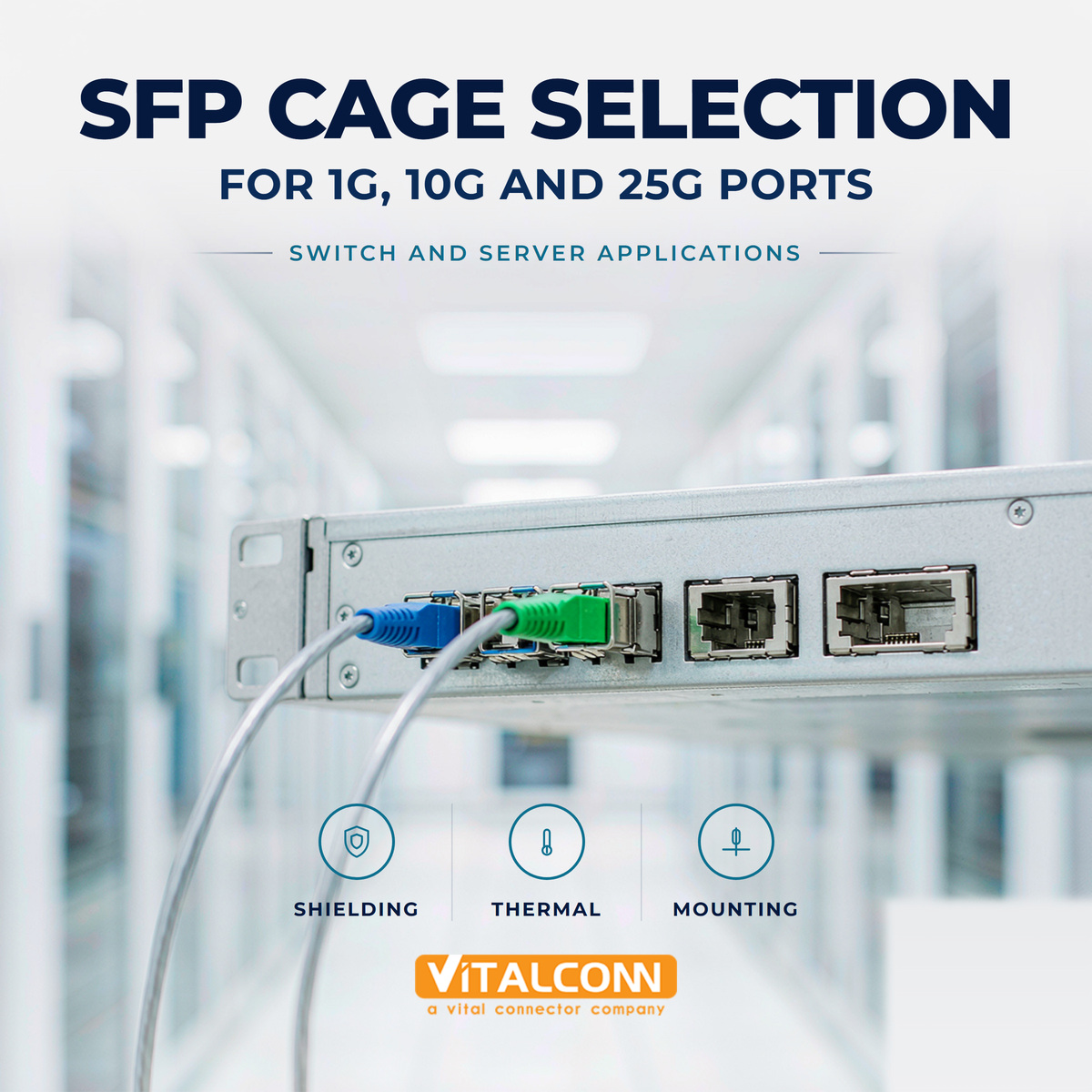
    SFP Cage Selection: The Data Rate Decides the Family SFP cage selection follows the data rate first, because the cage you choose must accept the modules your system will field now and later. For 1G, the classic SFP cage is a mature, commodity part. For 10G, SFP+ cage selection adds tighter EMI and signal-integrity expectations. For 25G, an SFP28 cage is the standard choice — mechanically the same form factor, electrically qualified for the faster SerDes. The good news for system designers: the mechanical envelope is common across the family, so the same board can often host SFP+ or SFP28 cages if the footprint was planned for it. Application Cage Family Module Data Rate Key Selection Drivers Fast/Gigabit Ethernet SFP cage 1 Gbps Cost, basic EMI fingers 10G Ethernet / Fibre Channel SFP+ cage 10 Gbps EMI finger quality, thermal path 25G Ethernet SFP28 cage 25 Gbps Full shielding, signal integrity, thermal Mixed-speed platforms SFP28-capable footprint 1–25 Gbps Forward-compatible design Step 1: Verify the Electrical Class, Not Just the Label Because SFP, SFP+, and SFP28 share a mechanical MSA, a cage that 'fits' every module is not automatically qualified for every module. At 25G, the SerDes edge rates produce harmonic energy that finds every aperture and every marginal grounding joint, so an SFP28 cage family will specify finer finger pitch, EMI-enhanced bezel features, and in the premium variants conductive gaskets around the bezel opening. Review the shielding section of our SFP cage EMI shielding guide for the fingers-versus-gasket analysis. Step 2: Thermal Design — the Cage Is a Heat Spreader At 10G and especially 25G, module power rises, and the cage becomes part of the cooling system. The module dumps heat into the cage through the crown spring fingers; the cage moves it into the board via mounting legs and into the airflow via its surface. Your SFP cage selection should therefore be made together with the enclosure airflow plan: bare cage for generous airflow, integrated or clip-on heatsink for dense or still-air designs. Confirm the vendor provides thermal resistance data and that your worst-case module power stays inside the module's allowed case temperature at your worst-case ambient. Match cage heatsink provision to module power class, not to average power. For ganged 1×N cages at 25G, evaluate all ports populated at full power simultaneously. Verify crown spring finger normal force — it is the thermal joint, and it is also the EMI joint. Step 3: Mounting and Footprint Decisions The mounting style — SMT for cost, press-fit for reliability — changes the ground joints and the assembly process; the full comparison is in our SFP cage mounting article. Whichever you choose, the SFP cage footprint and mechanical keep-out must be walked against your layout early, because the high-speed escape routing under a ganged cage is the single most constrained region of a switch board. Step 4: Port Count, Pitch, and Panel Planning Choose single (1×1) cages for few ports or irregular panels, ganged 1×N for uniform port fields. The fixed pitch of a ganged cage must match both the facepanel standard and your routing budget. For platforms that will host mixed data rates — a common case for access switches sold into different markets — standardizing the footprint across SFP+ and SFP28 cage families preserves the option to populate per SKU. The Selection Checklist Fix the module roadmap: which data rates will this port ever carry, at what module power? Select the cage family (SFP / SFP+ / SFP28) with margin above the fastest module you will field. Choose the shielding class: fingers, EMI-enhanced fingers, or full gasket, matched to your certification margin. Choose the thermal option: bare, integrated heatsink, or clip-on, validated against enclosure airflow. Pick the mounting method by reliability and assembly economics: SMT or press-fit. Verify footprint, keep-out, and panel cutout against the board and facepanel drawings. For 25G designs, review the connector's signal-integrity data (crosstalk, impedance continuity) — not just the shield features. For the underlying differences between cage families, read SFP cage vs SFP+ cage; for a broader introduction, the Ultimate Guide to SFP cage connectors covers the product family from first principles. Designing One Board for Multiple Data Rates The most cost-effective SFP cage selection is sometimes the one that supports a data rate the product does not ship with yet. Because SFP, SFP+, and SFP28 share the same mechanical envelope, a board designed for a 25G-capable cage and layout can carry 1G or 10G modules today and accept faster modules after a firmware release. The constraint is electrical: a 25G-ready design must route to 25G signal-integrity rules from day one, which costs PCB layers and material grade even while the product ships slower modules. For products with a five-year life and a plausible speed upgrade in the roadmap, that upfront cost is usually cheaper than a board re-spin. The thermal design deserves the same forward thinking. A cage sized for the thermal class of today's low-power 1G module may be marginal for the 25G module the roadmap promises. Since the cage is the heat spreader, its footprint, stitch vias, and copper pours should be designed for the hotter module even if the bill of materials starts with cooler ones. Reworking a thermal design after the board is frozen costs panel real estate and schedule; specifying it early costs a meeting. Route high-speed pairs to the highest data rate on the roadmap, then populate and test at the shipping rate Qualify the cage footprint and keepout against the tallest and hottest module on the roadmap, not just the shipping module Leave firmware and identification support for module classes you may add later, since the host must recognize new module types gracefully Document which layout elements are rate-limited, so a future speed upgrade starts from a known constraint list The upgrade path also has a procurement dimension worth one line in the design notes: cages rated for higher electrical classes are produced in the same mechanical families, so the mechanical and sourcing work done for 10G transfers almost unchanged to 25G. The engineering investment concentrates in layout and thermal, which is exactly where it pays back across a long product life. Frequently Asked Questions (FAQ) Can an SFP+ cage support 25G SFP28 modules? Mechanically yes — SFP, SFP+, and SFP28 share the same form factor. Electrically, 25G operation demands tighter EMI shielding and signal integrity, so an SFP28-rated cage family is recommended for designs that will run 25G modules. What is an SFP28 cage? An SFP28 cage accepts SFP28 modules for 25G Ethernet. It has the same mechanical envelope as SFP/SFP+ cages but is qualified for the higher SerDes rates, with tighter EMI shielding and signal-integrity specifications. Does an SFP cage selection affect thermal performance? Yes. The cage conducts module heat through its crown spring fingers into the board and the airflow. At 10G and 25G, the heatsink option and finger contact force are first-order thermal design decisions. Should I choose press-fit or SMT SFP cages for a 25G design? Both can work at 25G. Press-fit offers gas-tight ground joints and better thermal-cycling reliability; SMT offers lower assembly cost. The shielding and SI requirements are met by both when all legs are grounded. Can one board design host both SFP+ and SFP28 cages? Often yes, because the families share the mechanical envelope and similar footprints. Standardizing on an SFP28-capable footprint lets you populate different cages per SKU while keeping one board layout. Need the Right SFP Cage Connector for Your Application? Get samples, full datasheets, and FAE support from VITALCONN's SFP cage connector product line. Explore SFP Cage Connectors Request Samples
    Read More

leave a message

leave a message
If you are interested in our products and want to know more details,please leave a message here,we will reply you as soon as we can.
submit

home

products

whatsApp

contact