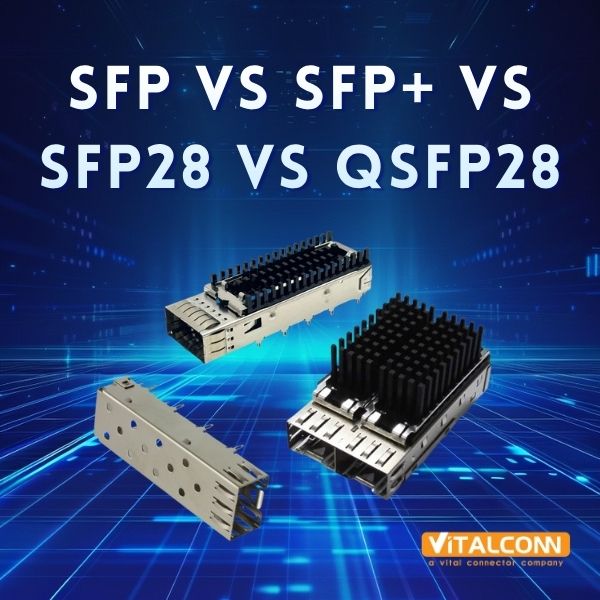
SFP vs SFP+ vs SFP28 vs QSFP28: Complete Speed & Compatibility Guide (2026)
Jun 23, 2026
As data centers scale from 1G to 800G and beyond, understanding the differences between SFP form factors is essential for network engineers, hardware designers, and procurement teams. This guide explains each SFP variant—its speed, application, cage connector requirements, and how to choose the right one for your infrastructure.
What Is an SFP Transceiver?
SFP (Small Form-factor Pluggable) is a hot-pluggable transceiver interface standard used in networking equipment. It defines both the optical/electrical module and the cage connector that hosts it on the PCB. The SFP ecosystem has evolved through multiple generations, each delivering higher data rates while maintaining backward compatibility with earlier form factors.
SFP vs SFP+ vs SFP28 vs QSFP28: Speed Comparison Table
Form Factor
Data Rate
Lane Count
Connector Type
Cage Keying
Typical Application
SFP
1 Gbps
1
LC / RJ45
SFP
Fast/Gigabit Ethernet, Fibre Channel
SFP+
10 Gbps
1
LC / RJ45
SFP (compatible)
10G Ethernet, 8G/16G FC
SFP28
25 Gbps
1
LC / RJ45
SFP (compatible)
25G Ethernet, 32G FC
QSFP+
40 Gbps
4×10G
MPO / LC
QSFP
40G Ethernet, InfiniBand FDR
QSFP28
100 Gbps
4×25G
MPO / LC
QSFP (compatible)
100G Ethernet, EDR InfiniBand
QSFP-DD
200/400 Gbps
8×25/50G
MPO-16 / LC
QSFP-DD
400G Ethernet, AI data centers
OSFP
200/400/800G
8×50/100G
MPO-16
OSFP
800G Ethernet, next-gen AI
Are SFP, SFP+, and SFP28 Backward Compatible?
Yes—this is one of the most important characteristics of the SFP ecosystem. The physical cage connector and electrical interface are designed for forward and backward compatibility:
Downshift: An SFP module can be inserted into an SFP+ or SFP28 cage (operates at 1G)
Upshift (limited): An SFP28 module can be inserted into an SFP+ cage (operates at 10G, not 25G)
Same cage: The physical dimensions of SFP, SFP+, and SFP28 modules are identical (same cage footprint)
This backward compatibility means that the same SFP cage connector on your PCB can support 1G, 10G, or 25G modules, protecting your hardware investment across network upgrades.
What Is the Difference Between SFP+ and QSFP+?
The key difference is the number of channels:
SFP+ provides a single 10G channel (1×10G). It uses a single TX/RX pair.
QSFP+ provides four 10G channels (4×10G) for an aggregate 40G bandwidth. It uses four TX/RX pairs in a wider cage.
Physically, QSFP+ cages are wider than SFP+ cages (approximately 18.35 mm vs 13.8 mm port width) and use a different keying system. A QSFP+ cage cannot accept an SFP+ module and vice versa.
QSFP28 vs QSFP-DD: The Path to 400G and 800G
As AI workloads and cloud infrastructure demand ever-higher bandwidth, the industry has moved beyond QSFP28:
QSFP-DD: QSFP-DD doubles the lane count from 4 to 8 while maintaining backward compatibility with QSFP28 modules. It supports 200G (8×25G) and 400G (8×50G).
OSFP: OSFP provides a larger form factor with 8 electrical lanes, supporting up to 800G (8×100G). It is not backward compatible with QSFP cages.
For data center designers planning for 800G, OSFP is the future-proof choice. For those upgrading existing 100G infrastructure to 400G, QSFP-DD offers the best migration path.
SFP Cage Connector Selection: Press-Fit vs Solder
Beyond the transceiver module itself, the cage connector that mounts on the PCB is equally critical. Two primary mounting technologies are available:
Solder-Type Cages
Lower initial tooling cost
Requires wave soldering or selective soldering process
Higher FIT (Failures In Time) values—typically 10–30× higher than press-fit
Risk of solder joint cracks under thermal cycling
Press-Fit Cages
No soldering required—cold-rolled compliant pins press into plated through-holes
FIT values 10–30× lower than solder, significantly improving reliability
Compatible with lead-free RoHS processes
Eliminates the wave soldering step, reducing assembly cost and time
💡 Tip: VITALCONN offers 89 press-fit SFP cage models—the broadest selection in the industry. For high-reliability data center applications, press-fit is strongly recommended.
SFP Cage EMI Shielding: Why It Matters at 25G and Above
At data rates of 25Gbps and above, electromagnetic interference (EMI) becomes a critical design concern. SFP cages must provide effective shielding to prevent signal integrity degradation and meet FCC/CE emissions requirements.
VITALCONN SFP cages use beryllium copper (BeCu) EMI gaskets and spring fingers that provide 360° grounding contact around the transceiver module. This design achieves crosstalk levels below -40 dB at 10 GHz, ensuring reliable signal integrity even in high-density, multi-port configurations.
SFP Cage Cross-Reference: Replacing TE Connectivity Parts
VITALCONN P/N
TE P/N
Description
Mounting
S2N3104800NA4
2007215-1
1×1 SFP+ Cage
Press-Fit
S2N3122055NA4
2149730-1
1×1 SFP+ Cage w/ EMI
Press-Fit
S2N32H0206NA4
2227303-2
2×6 QSFP28 Cage
Press-Fit
S1N34L0100NA4
1761014-3
1×1 SFP28 Cage w/ Heatsink
Press-Fit
See our complete TE SFP Cage Cross-Reference Guide for all 27 pin-to-pin replacement options.
How to Choose the Right SFP Form Factor for Your Design
Use this decision framework:
1G Ethernet, legacy Fibre Channel → SFP
10G Ethernet, 16G FC → SFP+
25G Ethernet, 32G FC → SFP28
40G Ethernet → QSFP+
100G Ethernet → QSFP28
400G Ethernet → QSFP-DD
800G+ / AI training clusters → OSFP
⚠ Important: For the cage connector, always choose press-fit mounting unless your PCB assembly process cannot support it. The reliability improvement alone justifies the slightly higher per-unit cost.
Frequently Asked Questions (FAQ)
Can I use an SFP+ module in an SFP28 cage?
Yes. SFP28 cages are mechanically and electrically compatible with SFP+ modules. The module will operate at its rated 10G speed when inserted into an SFP28 cage.
What is the maximum cable distance for SFP+?
It depends on the module type. SFP+ SR (short-range) multimode fiber supports up to 300 m. SFP+ LR (long-range) single-mode fiber supports up to 10 km. SFP+ DAC (direct attach copper) cables support 1–5 m for rack-level connections.
Why choose press-fit SFP cages over solder?
Press-fit cages provide 10–30× lower FIT values, eliminate solder joint failure risks, are compatible with RoHS lead-free processes, and reduce assembly cost by removing the wave soldering step. For high-reliability data center applications, press-fit is strongly recommended.
Ready to Find the Right SFP Cage Connector?
Explore VITALCONN's full range of SFP cages—89 press-fit models, pin-to-pin TE/Molex/Amphenol replacements—or request free samples for your next project.
Explore SFP Cages Request Samples
Read More



 IPv6 network supported