Nano SIM vs Micro SIM vs Standard SIM: Complete Comparison Guide (2026)
Jun 18, 2026
Choosing the right SIM card form factor is one of the first decisions engineers face when designing connected devices. Whether you are building a slim smartphone, a compact IoT sensor, or an industrial gateway, understanding the differences between Standard SIM, Micro SIM, and Nano SIM is critical for selecting the correct SIM card socket connector. This guide provides a detailed comparison to help you make an informed design choice.
What Are the Three SIM Card Sizes?
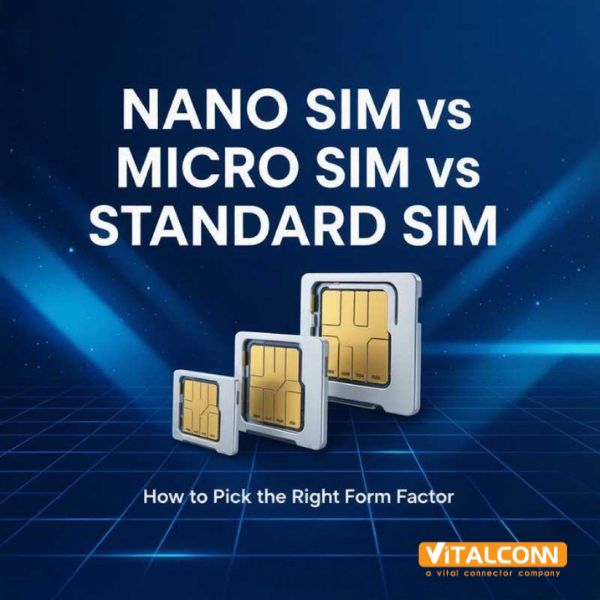
SIM cards come in three standardized physical sizes defined by ETSI and ISO/IEC 7810. All three carry identical electrical contacts and functionally perform the same — the only difference is the physical form factor.
SIM Type
Dimensions (mm)
Area (mm²)
Thickness (mm)
Introduced
ISO Standard
Standard SIM (1FF)
85.6 × 53.98
4,621
0.76
1991
ISO 7810 ID-1
Micro SIM (3FF)
15.0 × 12.0
180
0.76
2003
ETSI TS 102 221
Nano SIM (4FF)
12.3 × 8.8
108.24
0.67
2012
ETSI TS 102 221 V11.0.0
The progression from Standard to Micro to Nano SIM has been driven entirely by the demand for smaller, thinner devices. A Nano SIM is approximately 97.7% smaller in area than a Standard SIM, freeing up valuable PCB real estate for other components.
Nano SIM vs Micro SIM vs Standard SIM: Key Differences at a Glance
Feature
Standard SIM
Micro SIM
Nano SIM
Dimensions
85.6×53.98 mm
15×12 mm
12.3×8.8 mm
Contact pad size
Full card
Same as Standard
Slightly reduced
Electrical function
Identical
Identical
Identical
Typical use today
Legacy devices
Older smartphones, M2M
Modern phones, IoT, wearables
PCB footprint
Very large
Compact
Ultra-compact
Socket connector height
H3.0~5.0 mm
H1.5~3.0 mm
H1.13~2.5 mm
Adapter available
N/A
Yes (to Standard)
Yes (to Micro/Standard)
When Should You Use a Nano SIM?
The Nano SIM is the dominant form factor for modern designs. You should choose Nano SIM when:
Your device has strict space constraints — smartphones, wearables, medical devices
You need the lowest-profile SIM socket — as thin as 1.13 mm for push-push type
Your target market uses current-generation mobile networks — 4G/5G
You want forward compatibility — with the latest carrier SIM cards
💡 Tip: VITALCONN offers Nano SIM card sockets as thin as 1.13 mm in a push-push configuration — among the slimmest available in the industry. These sockets are ideal for portable devices where every millimeter of Z-height matters.
When Should You Use a Micro SIM?
While Nano SIM has largely replaced Micro SIM in consumer devices, there are still valid use cases:
Legacy product lines that have not yet migrated to Nano SIM
Industrial M2M modules that ship with Micro SIM form factor
Automotive telematics systems designed before 2018
Cost-sensitive designs where Micro SIM sockets are marginally cheaper
Is Standard SIM Still Relevant?
Standard SIM is rarely used in new product designs. However, it still appears in:
Industrial equipment with legacy SIM readers
Banking and payment terminals (Smart Card form factor)
Older networking and telecom hardware
⚠ Important: For new designs, VITALCONN recommends Nano SIM as the default choice unless legacy compatibility is a specific requirement.
SIM Card Socket Connector Selection Guide
Selecting the right SIM card socket connector involves more than just matching the SIM form factor. Key parameters include:
Mounting Type
Push-Push: User inserts and ejects the card with a spring mechanism. Best for consumer devices where the end user swaps SIM cards.
Push-Pull: User pulls the card out manually. Common in industrial devices where the SIM is inserted once and rarely removed.
Hinged/Trap: Card slides under a hinged cover. Provides the most secure retention for high-vibration environments.
Profile Height
Socket height is often the most critical dimension in slim device design:
Application
Recommended Height
VITALCONN Example
Ultra-slim phones/wearables
H1.13~1.5 mm
VTC102016832E1 (Push-Push, H1.25mm)
Tablets/laptops
H1.5~2.2 mm
VTC402013832E1 (Push-Push, H1.65mm)
IoT gateways/routers
H2.0~3.0 mm
VTC102016832E2 (Push-Push, H2.5mm)
Industrial equipment
H2.5~5.0 mm
VTC102016838E1 (Push-Pull, H3.0mm)
Environmental Ratings
For applications exposed to harsh conditions, consider sockets with operating temperature ranges of -40°C to +85°C and compliance with EIA-364 environmental testing standards. VITALCONN SIM card sockets are tested per EIA-364 for thermal shock, salt spray corrosion, temperature cycling, and solderability (245±5°C).
SIM Card Socket Cross-Reference: Replacing Molex and JAE Parts
Many designs originally specified Molex or JAE SIM card sockets. VITALCONN provides pin-to-pin compatible replacements with shorter lead times and competitive pricing:
VITALCONN P/N
Competitor P/N
Brand
Description
VTC102016832E1
SF72S006VBDR2500
JAE
Nano SIM Push-Push H1.25mm
VTC402013832E1
5039600695
Molex
Micro SIM Push-Push H1.65mm
VTC402013832E2
5027740891
Molex
Micro SIM Push-Push H2.5mm
VTC102016832E2
105162-0001
Molex
Nano SIM Push-Push H2.5mm
These cross-reference options offer 30–40% cost savings and 2–4 week lead times versus 12–24 weeks for the original parts.
Frequently Asked Questions (FAQ)
Can I cut a Standard SIM into a Nano SIM?
Technically, yes — SIM card cutters exist that trim a Standard or Micro SIM down to Nano SIM size. However, this is not recommended for production devices because the cut edges can damage the socket contacts, and the reduced thickness of a Nano SIM (0.67 mm vs 0.76 mm) may cause contact reliability issues.
Are Nano SIM and Micro SIM electrically identical?
Yes. All three SIM sizes use the same 8-contact ISO/IEC 7816 interface. The electrical specifications are identical — the only differences are the physical dimensions of the plastic carrier.
What is the minimum profile height for a Nano SIM socket?
The thinnest Nano SIM sockets available are approximately 1.13 mm in profile height. VITALCONN offers push-push Nano SIM sockets starting from H1.25 mm, suitable for ultra-slim device designs.
How many insertion cycles can a SIM card socket handle?
Quality SIM card sockets are rated for 5,000 to 10,000 insertion cycles. VITALCONN SIM sockets are tested to 5,000 cycles minimum per EIA-364 standards.
Ready to Find the Right SIM Card Socket?
Explore VITALCONN's full range of SIM card sockets or request free samples for your next project.
Explore SIM Card Sockets Request Samples
Read More




 IPv6 network supported