Leave A Message
If you are interested in our products and want to know more details,please leave a message here,we will reply you as soon as we can.
submit

hot swap cage connector

Home

hot swap cage connector

  • What Is an SFP Cage? Everything You Need to Know About Fiber Optic Transceiver Housings
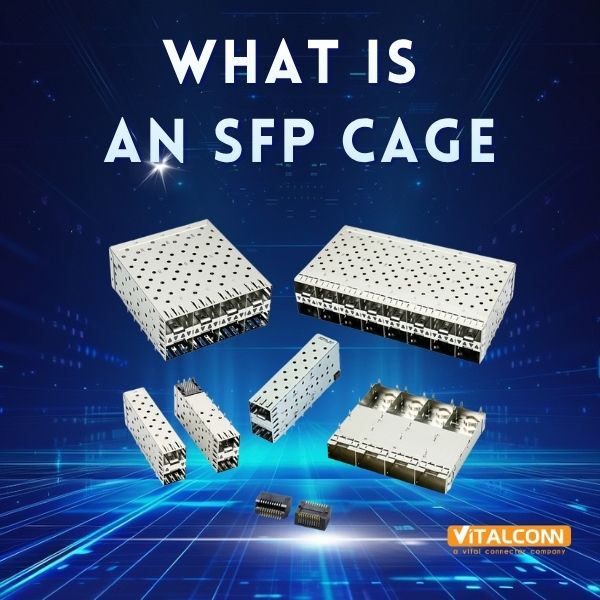
    What Is an SFP Cage? Everything You Need to Know About Fiber Optic Transceiver Housings
    Apr 27, 2026
    If you've ever looked at the back of a network switch, a server, or a fiber-to-Ethernet media converter, you've seen them: a row of rectangular metal-framed slots, each about the size of two fingers side by side, waiting for a small modular plug to slide in. Those slots are SFP cages — and they are far more than simple metal boxes. Despite being one of the smallest components on a network board, the SFP cage directly affects your product's electromagnetic compliance, thermal performance, and module interoperability. Getting the wrong cage can mean failed FCC tests, overheating modules in the field, or modules that simply don't fit. In this article, we'll explain what an SFP cage is, how it works, the different types available, and why choosing the right one matters more than you might think. Definition: What Exactly Is an SFP Cage? An SFP cage (Small Form-factor Pluggable cage) is a passive electromechanical receptacle mounted on a printed circuit board (PCB) that serves as the housing for a pluggable optical or copper transceiver module. The cage provides: Mechanical retention for the SFP module, ensuring it stays firmly seated during vibration, thermal cycling, and cable handling Electromagnetic shielding that contains high-frequency emissions and prevents external interference Thermal conduction that transfers heat from the module to the PCB, chassis, or heatsink ESD protection through a grounded metal shell for safe hot-swap events Electrical interface routing — connecting the module's signals to the host PCB's differential pairs Key point: The SFP cage is a passive component — it contains no active electronics. However, its mechanical and electrical design has a profound impact on system-level performance. The SFP cage is defined by the SFP Multi-Source Agreement (MSA), a set of specifications developed jointly by transceiver manufacturers to ensure interoperability between modules and host systems. The MSA specifies mechanical dimensions, pin assignments, and electrical characteristics. A Brief History of the SFP Form Factor Era Form Factor Data Rate Key Innovation Early 2000s SFP 1.25 Gbps Replaced larger GBIC, 50% size reduction ~2006 SFP+ 10 Gbps Same footprint, 10× the speed ~2014 SFP28 25/28 Gbps Optimized for single-lane 25G Ethernet ~2013 QSFP+ 40 Gbps 4 channels, enhanced EMI ~2016 QSFP28 100 Gbps 4 × 25G channels ~2017 QSFP-DD 400 Gbps Double-density, 8 channels ~2019 SFP-DD 100 Gbps Dual-channel SFP The Anatomy of an SFP Cage 1. Cage Housing (Shell) The outer metal shell is typically made from phosphor bronze or beryllium copper, stamped and formed into a rectangular housing. Shell thickness is typically 0.3–0.4 mm. Some cages use a two-piece shell (top cover + bottom tray) for easier manufacturing; others are a one-piece drawn shell for superior EMI continuity. 2. EMI Fingers (Gasket Fingers) Spring-loaded metal fingers protrude inward from the cage walls. When a module is inserted, these fingers press against the module's metal housing, creating a continuous conductive seal. Standard cages have 4–6 EMI fingers per side; enhanced EMI cages (SFP+ and above) may have 8–12 per side. 3. Contact Pads (Signal Interface) The bottom of the cage features contact pads that mate with the SFP module's edge connector — typically gold over nickel (Au/Ni) plating with minimum 0.76 μm gold thickness. The standard 20-pin configuration includes signal pairs (TD+/TD-, RD+/RD-), power pins (VccT, VccR, GND), control signals (ModSel, LOS, TxFault, TxDisable), and I2C pins (SDA, SCL). 4. Module Detection Mechanism Most SFP cages include a module-absent (ModAbs) switch — a small spring-loaded lever that detects module insertion. When the module pushes the lever, the switch state changes, enabling hot-swap detection, module identification (via EEPROM), and link management. 5. Cage Leads (Mounting Terminals) Through-hole cages use metal pins soldered through the PCB (excellent mechanical strength). Surface-mount cages use flat tabs for reflow soldering (lower profile, automated assembly). Ground leads are critical — a well-designed cage will have dedicated ground pads around the entire perimeter. How Does an SFP Cage Work? Step by Step Module approach → EMI contact → Electrical mating → Module detection → Link establishment → Continuous operation → Hot removal Module approach: The module enters the cage opening. Internal alignment features guide the module into position. EMI contact: EMI fingers press against the module housing, establishing a conductive seal — before the electrical pins mate (make-first grounding). Electrical mating: The module's edge connector slides onto the cage's contact pads. Power is applied. Module detection: The ModAbs lever triggers the detection switch. The host reads the module EEPROM via I2C. Link establishment: The PHY negotiates the link (autonegotiation or fixed config). The module begins transmitting. Continuous operation: The cage maintains mechanical retention, EMI shielding, and thermal conduction. Hot removal: The user pulls the module. ModAbs detects removal, the host disables the PHY, and EMI fingers break after signal pins. SFP vs. SFP+ vs. QSFP: What's the Difference? Feature SFP SFP+ QSFP28 Max speed 1.25 Gbps 10 Gbps 100 Gbps Channels 1 1 4 Cage size 13 × 57 mm 13 × 57 mm 18 × 72 mm Power/port < 1 W 1–1.5 W 3.5–4.5 W EMI shielding Basic Enhanced Multi-channel MSA spec SFF-8074 SFF-8431 SFF-8665 Key application Access switches Enterprise / DC Core / spine Why the SFP Cage Matters More Than You Think EMI Compliance A poorly shielded cage can cause your product to fail FCC or CE radiated emission tests — potentially adding months of redesign and re-certification. The cage is often the single largest contributor to (or defense against) radiated emissions on the board. Module Interoperability Tolerances accumulate. A cage with tight internal dimensions may reject modules from certain vendors. A cage with loose dimensions may allow excessive play, causing intermittent contact failures. Fit-checking with modules from multiple vendors during design is essential. Thermal Throttling Modern SFP28 and QSFP28 modules operate at the thermal limit. If the cage doesn't conduct heat efficiently, the module's temperature sensor will trigger thermal shutdown — your link drops and throughput falls to zero. Reliability in Harsh Environments For industrial applications (factory automation, outdoor telecom, transportation), the cage must withstand wide temperature ranges (-40°C to +85°C), vibration and shock, humidity, and 500+ hot-swap cycles. Cages made from standard nylon may warp or become brittle under these conditions — LCP material is required. How to Choose an SFP Cage: Quick Decision Guide Your Requirement Recommended Cage Type 1G Ethernet, cost-sensitive Standard SFP, through-hole, basic EMI 10G Enterprise switch SFP+ with EMI fingers, surface-mount 25G Data-center leaf SFP28, enhanced EMI, thermal pad option 40G Aggregation QSFP+, multi-channel shielding 100G Core switch QSFP28, thermal cage with heatsink clip 400G Hyperscale QSFP-DD or OSFP with active cooling Industrial / outdoor Through-hole, LCP, -40 to +85°C rated Mixed 1G/10G deployment SFP+ cage (backward-compatible with SFP) About VITALCONN VITALCONN Electronics Technology is a professional manufacturer of SFP cages and other network interface connectors based in Shenzhen, China. With over 15 years of experience, we serve network equipment manufacturers, EMS providers, and connector distributors worldwide. Full SFP cage range: SFP, SFP+, SFP28, QSFP, QSFP+, QSFP28, QSFP-DD, OSFP EMI finger option: Standard and enhanced shielding versions Custom configurations: Non-standard port counts, branded bezels, special materials Certifications: ISO 9001, ISO 14001, RoHS, REACH, UL MOQ: 100 pieces for standard catalog items Need datasheets, S-parameters, or free samples? 📧 sales@vitalconn.com | 🌐 www.vitalconngroup.com / www.vitalconn.com  FAQ Q1: Is an SFP cage the same as an SFP module? No. The SFP cage is the receptacle permanently mounted on the PCB. The SFP module (transceiver) is the pluggable device you insert into the cage. The cage provides mechanical housing, EMI shielding, and the electrical interface; the module contains the active optical/electronic components. Q2: Can any SFP module work in any SFP cage? Generally yes, within the same speed class. However, minor dimensional tolerances between cage manufacturers mean that a fit-check is always recommended, especially if you need to support modules from multiple vendors. SFP+ modules require cages specifically rated for 10G operation. Q3: What material are SFP cages made from? The metal shell is typically phosphor bronze or beryllium copper with gold-over-nickel plating. The insulating body is typically LCP (Liquid Crystal Polymer) for high-temperature applications, or PBT/PA9T for standard applications. LCP offers superior dimensional stability at temperatures above 260°C. Q4: Do I need EMI fingers on my SFP cage? EMI fingers are strongly recommended for any design operating at 10 Gbps (SFP+) or above, and for any product that must pass FCC Class B or EN 55032 radiated emission limits. For 1G applications in controlled environments, a standard cage without EMI fingers may be sufficient — but verify through EMC testing. Q5: What does "hot swap" mean for an SFP cage? Hot swap means you can insert or remove an SFP module while the host system is powered on. The cage supports this by ensuring ground contact is made before signal pins (make-first) and broken after signal pins (break-last). The ModAbs switch alerts the host firmware to handle the event gracefully. Q6: How do I get S-parameter data for an SFP cage? Contact your cage manufacturer directly. Reputable suppliers like VITALCONN provide S-parameter (touchstone) files for their SFP cage products upon request. These files are essential for signal-integrity simulation in tools like ADS, HFSS, or HyperLynx. © 2026 VITALCONN Electronics Technology (Shenzhen) Co., Limited. All rights reserved. | www.vitalconngroup.com
    Read More

  • SFP Cage Types & Selection Guide: How to Pick the Right Transceiver Cage for Your Design
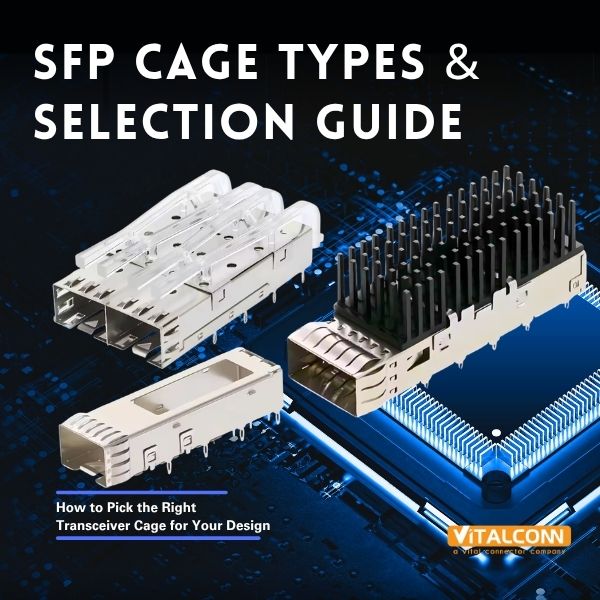
    SFP Cage Types & Selection Guide: How to Pick the Right Transceiver Cage for Your Design
    Apr 27, 2026
    Whether you're designing a 1GbE switch, a 400G data-center spine, or an industrial PoE extender, the SFP cage is one of the most critical mechanical components on your PCB. It defines the optical interface, the module compatibility, the thermal path, and — often overlooked — the electromagnetic integrity of the entire transceiver subsystem. Yet many engineers treat the cage as a commodity afterthought: pick a 20-pin SFP cage from the catalog, check the price, and move on. That shortcut can lead to compliance failures, overheating, module interoperability issues, and costly board re-spins. In this guide, we'll walk through every SFP cage form factor, explain the key selection parameters, and give you a practical decision framework that covers speed, thermal, shielding, and mounting considerations. What Is an SFP Cage? An SFP cage is a receptacle housing mounted on a PCB that receives and secures a pluggable optical or copper transceiver module. The cage provides: Physical retention — holds the module firmly and ensures proper alignment of the electrical contacts EMI containment — prevents radiated emissions from the transceiver from coupling into adjacent circuitry Thermal management — conducts heat from the module to the PCB and/or chassis ESD protection — shields sensitive PHY-side electronics from static discharge during hot-swap events Module identification — some cages integrate detect pins, I2C EEPROM access, and loss-of-signal (LOS) pins SFP cages are passive components — they contain no active silicon — but their mechanical, thermal, and electrical design profoundly affects system performance. SFP Cage Form Factor Comparison The SFP ecosystem has evolved through several generations, each doubling (or more) the data rate: Form Factor Max Data Rate Channels Typical Application SFP 1.25 Gbps 1 Access switches, routers, industrial Ethernet SFP+ 10 Gbps 1 Enterprise switches, servers, storage SFP28 28 Gbps 1 25G/28G data-center leaf switches QSFP 40 Gbps 4 40G aggregation, data-center spine QSFP28 100 Gbps 4 100G data-center core QSFP-DD 400 Gbps 8 400G/800G hyperscale SFP-DD 100 Gbps 2 Dual-channel SFP for edge routers Key takeaway: SFP, SFP+, and SFP28 share the same cage footprint — the difference is in the signal integrity and thermal capability of the cage design. If you design your PCB for an SFP+ cage, you're also mechanically compatible with SFP and SFP28 modules. How to Select the Right SFP Cage: 7 Critical Parameters 1. Data Rate and Signal Integrity The data rate is your starting point, but it's not just about the number — it's about signal integrity at that speed: Up to 1.25 Gbps (SFP): Standard 20-pin cage with basic EMI shielding is sufficient. 10 Gbps (SFP+): Requires impedance-controlled contacts, tighter ground-plane stitching, and improved EMI gasketing. 25–28 Gbps (SFP28): Demands minimized stub lengths, reference-plane continuity, and ground vias within 0.5 mm of every signal via. 40–100 Gbps (QSFP/QSFP28): Multi-channel crosstalk management required. Cage must have internal shielding partitions (> 20 dB isolation). 400 Gbps (QSFP-DD, OSFP): Cage designed as part of SI simulation package. S-parameter models (touchstone files) essential. 💡 Selection tip: Always ask your cage supplier for S-parameter data for the specific cage part number. A reputable manufacturer like VITALCONN provides this data upon request. 2. Number of Ports and Cage Density Configuration Cage Count Typical Use Single-port 1 Edge routers, industrial equipment Dual-port 2 Small managed switches 4-port 4 Access switches 8-port 8 Aggregation switches 24-port 24 Enterprise edge switches 48-port 48 Core / aggregation switches 3. EMI Shielding and Grounding The EMI performance of an SFP cage is determined by several design elements: EMI fingers (gasket fingers): Spring-loaded metal fingers that maintain continuous contact between the cage and the transceiver module shell. Critical at 10G+ rates. Cage grounding scheme: Multiple ground vias around the cage footprint. Minimum 4 per side for SFP+; 8+ per side for QSFP28. Internal shielding partitions: Multi-channel cages should have metal partitions between channel pairs to prevent crosstalk. EMI cover (bezel): Metal cover over the module area for enhanced shielding. More cost-effective than full shrouds. 4. Thermal Management Module Type Typical Power SFP (1G) 0.5 – 1.0 W SFP+ (10G) 1.0 – 1.5 W SFP28 (25G) 1.5 – 2.0 W QSFP28 (100G) 3.5 – 4.5 W QSFP-DD (400G) 12 – 14 W 💡 Selection tip: Always derate by 20%. If a module's datasheet says 3.0 W max, design the thermal solution for 3.6 W. 5. Mounting Style: Through-Hole vs. Surface-Mount Parameter Through-Hole (TH) Surface-Mount (SMD) Mechanical strength Excellent Good Assembly cost Higher Lower (reflow) PCB height Taller Flatter profile Best for Industrial, automotive High-volume, data center 6. Hot-Swap Capability Hot-swapping is a core feature of the SFP ecosystem. The cage plays a critical role: Shield grounding: The cage ground must make contact before the signal pins (make-first, break-last grounding). Module detection: The cage routes the module-present (ModAbs) signal for insertion/removal detection. ESD protection: The cage provides a grounded shell that shunts ESD events away from the PHY. 7. Compliance and Certifications For regulated markets, verify these standards: IEC 61753-1: Fiber optic interconnecting devices IEEE 802.3: Ethernet physical layer SFF-8074 / SFF-8431: SFP/SFP+ MSA specifications SFF-8636 / SFF-8665: QSFP+/QSFP28 MSA specifications RoHS / REACH: Mandatory for EU market UL 94 V-0: Flammability rating (LCP or high-temp nylon housing) SFP Cage Selection Checklist Step Check Notes 1 Define max data rate SFP / SFP+ / SFP28 / QSFP28 / QSFP-DD 2 Choose form factor Single / multi-port 3 Confirm MSA compatibility SFF-8074 / SFF-8636 / CMIS 4 Check EMI requirements FCC / CE / internal shielding 5 Calculate thermal budget Module power × port count 6 Select mounting style Through-hole vs. surface-mount 7 Verify hot-swap sequencing Ground-first make / break-last 8 Confirm certifications RoHS, REACH, UL 94 V-0 9 Request S-parameters For SI simulation 10 Order samples for fit-check Test with target modules Common Mistakes When Choosing an SFP Cage 1. Ignoring the Grounding Scheme Many PCB designers treat the cage pads as "just another component footprint." In reality, the cage ground vias are critical for EMI performance. A single ground via on one corner will create a ground loop and compromise shielding. 2. Using the Wrong Cage for the Speed Grade An SFP cage rated for 1 Gbps may physically accept a 10 Gbps SFP+ module, but won't provide adequate EMI shielding at 10 GHz harmonics. Always match the cage rating to your speed requirement. 3. Underestimating Thermal Requirements A 48-port SFP28 switch generates significant heat. If the cage thermal path is poor, modules will thermally throttle, reducing throughput or dropping links entirely. 4. Not Checking Module Compatibility Tolerances vary between cage and module vendors. If your product must support modules from multiple vendors, order cage samples and perform a fit-check with modules from at least 3 different suppliers. 5. Choosing Price Over Quality Budget cages may use lower-grade materials (recycled nylon instead of LCP), imprecise stamping, or minimal quality inspection. The cost savings are never worth the field failure rate. Why VITALCONN? VITALCONN has been manufacturing SFP cages and optical transceiver housings for over 15 years: Full form-factor coverage: SFP, SFP+, SFP28, QSFP, QSFP+, QSFP28, QSFP-DD, and OSFP cages EMI finger option: Standard and EMI-finger-enhanced versions for high-speed designs Material options: LCP (high-temp), PBT, and PA9T housing materials Custom configurations: Non-standard port counts, custom colors, branded bezels ISO 9001 & ISO 14001 certified manufacturing Full RoHS/REACH compliance with test reports available MOQ: 100 pieces for standard catalog items Samples: Available for mechanical and thermal validation Ready to specify the right SFP cage for your design? Contact our engineering team for datasheets, S-parameters, and free samples. 📧 sales@vitalconn.com | 🌐 www.vitalconngroup.com / www.vitalconn.com  FAQ Q1: What is the difference between an SFP cage and an SFP+ cage? While they share the same mechanical footprint (~13 × 57 mm), SFP+ cages are designed for 10 Gbps operation and feature enhanced EMI shielding (often with EMI fingers), impedance-controlled contacts, and improved thermal characteristics. An SFP+ cage can typically be used for 1G SFP modules, but an SFP cage may not meet EMI requirements at 10G speeds. Q2: Can I use an SFP28 module in an SFP+ cage? Mechanically yes — SFP, SFP+, and SFP28 all share the same cage footprint. However, for 25G/28G operation, a cage specifically rated for SFP28 speeds is recommended to ensure adequate signal integrity and EMI shielding at higher frequencies. Q3: What are EMI fingers on an SFP cage? EMI fingers (also called gasket fingers) are small spring-loaded metal contacts on the interior walls of the cage. They press against the metal shell of the inserted SFP module, creating a continuous conductive seal that contains high-frequency electromagnetic emissions. EMI fingers are essential for designs operating at 10 Gbps and above. Q4: How do I know if I need a through-hole or surface-mount SFP cage? Choose through-hole for industrial, automotive, or high-vibration applications where mechanical robustness is critical. Choose surface-mount for high-volume data-center equipment where automated reflow soldering reduces assembly cost. Q5: What is the typical lead time for custom SFP cages? Standard catalog SFP cages ship within 5–7 business days. Custom configurations typically require 3–4 weeks for tooling and first-article inspection. VITALCONN maintains stock of popular configurations for rapid prototyping. Q6: Are SFP cages compatible with copper (DAC) modules? Yes. SFP cages support both optical transceivers and direct-attach copper (DAC) cables. The cage is agnostic to the module type — it provides the mechanical housing, EMI shielding, and thermal path regardless of whether the module converts electrical signals to optical or stays copper.  
    Read More

leave a message

leave a message
If you are interested in our products and want to know more details,please leave a message here,we will reply you as soon as we can.
submit

home

products

whatsApp

contact